Automation complacency

I. The Accident Report Nobody Read

  • The story of AF447: a routine flight, a 40-second sensor failure, a functional aircraft, 228 dead1
  • The investigation’s core finding: the skills had not been correctly developed and maintained2

II. The Automation Paradox

  • The better automation gets, the more dangerous the handback becomes3
  • Aviation researchers named this dynamic: automation complacency4
  • The FAA eventually required airlines to reintroduce manual flying into routine operations5

III. The Cockpit We’re Building

  • AI coding assistants are autopilot for software development — and the near-term pitch is largely true
  • The act of construction encodes differently than the act of review6
  • Offshoring research established the precedent: the knowledge that disappears is the knowledge that was never written down7

IV. The Lag

  • The costs and benefits of automation don’t arrive on the same timeline
  • VC funds velocity, not five-year consequences — this is structural, not conspiratorial
  • Offshoring delivered the same short-term metrics and the same deferred costs8

V. What the FAA Did

  • The FAA didn’t ban autopilot — it required deliberate, scheduled friction9
  • Core principle: you cannot maintain the ability to take over a system you never operate[^10]

VI. What You Can Do Today

  • Maintain currency — build components by hand on a regular cadence; the skill expires without practice[^11]
  • Own the architecture — AI executes decisions, it doesn’t make them; that knowledge must live somewhere human
  • Name the handback scenario — if the tooling disappeared tomorrow, what would you be unable to do?

Closing

  • Return to the accident report: the assumption of readiness was never tested until the moment it couldn’t be
  • We are making the same assumption — we just haven’t hit the water yet


  1. Bureau d’Enquêtes et d’Analyses (BEA), Final Report on the Accident on 1st June 2009 to the Airbus A330-203 Flight AF 447, July 2012 (PDF). ↩︎

Read more →

Unicorn season

The “10x engineer” was always a myth dressed up as a talent strategy. Now we have the 100x engineer, and soon the 1000x engineer. This is pure rhetorical escalation with zero analytical foundation.

The number keeps growing because nobody ever had to define it.

What nobody’s asking is why there seems to be no actual proof that these engineers are changing the course of product development. Successful products are built and maintained without them, and teams of very capable engineers scuttle projects left and right.

Read more →

Prose has no compiler

In the distributed, fast-paced world we occupy, writing has never been a more important tool to share ideas, align goals, and record events. In my piece On the importance of writing, I propose that writing is the sieve through which you pass the brain slop of fuzzy thinking to clarify and pressure-test it. I have never believed more strongly in that idea.

Meanwhile, an ever-growing array of AI tools is perpetuating the same flawed and dangerous assumption that I saw when I wrote that piece: that writing is a mechanical process that turns existing ideas into an artifact, and that it can be delegated to someone (or something) else.

This is making me angry, and when I get angry, I write.

Read more →

The velocity bubble 🔊

We’ve been seduced by the apparent speed of AI coding assistants. Social media is buzzing with stories about features shipping in hours instead of weeks, exclamations of “we rewrote our entire frontend in a weekend!” and CEOs boasting about shipping an MVP themselves in mere days with no help.

These observations are true enough, but we’re developing “velocity tunnel vision,” and the light at the end of this tunnel is the headlight of a fast-approaching train. We’ve been hit by this train before, and back then it was called offshoring.

Read more →

AI is strip mining the future 🔊

A study in The Lancet Gastroenterology & Hepatology in 2025 made a startling observation about AI “de-skilling.” They took a bunch of experienced doctors (27+ years, 2,000+ procedures each) and gave them AI-assisted scopes for identifying colon polyps. After three months, they took the AI assistance away.

Returning to their original way of working, these doctors lost 21% of their detection accuracy. The AI improved outcomes, it worked great, but when it went away they had forgotten how to do the job they’d been doing for decades.

Read more →

Loyalty 🔊

I’ve been thinking a lot about loyalty lately.

My grandfather wrote at least a few lines in a journal every day for something like forty years. My dad has a box of these little annual journal books and the only gap was when my dad was born. He’d write down what the weather was like, what happened that day, maybe how he felt about it.

Through those journals, we can trace his professional life.

Read more →

The phase mismatch

Challenge the assumption that “failure to adapt” is, in fact, a failure. Instead, individuals have different temperaments and skills that lend themselves to specific phases of company growth.

  • Chaos/founding (0-1 product, survival mode)
  • Structure/scaling (product-market fit found, processes emerging)
  • Optimization/maturity (established systems, efficiency focus)
  • Bureaucracy/ossification (the optional dystopia stage)

A preference for one or more of these typical phases is natural and even common. For managers, this means understanding what phase they work best in, and also understanding that a phase mismatch among their direct reports is also quite likely to happen over time.

Read more →

The AI post

All anyone wants to talk or write about is AI, and I’ve been avoiding it because I didn’t feel like my voice could add much to the cacophony of other, smarter, and more experienced ones. But I do have my opinions, and I haven’t come across this angle yet, so here we go.

Read more →

Having principles hurts sometimes

If everyone in the world just did whatever felt good to them in the moment, like some kind of hedonistic automatons, I think we can agree that most of what makes it tolerable to live in a society would go right out the window. Living together and working together as humans requires at least some modest guidelines.

What those guidelines look like and how they’re enforced is the subject of every leadership and organizational book ever written, whether they say it aloud or not. Who to hire, what to pay them, what work they should do, how they’re rewarded or punished for their behavior are all essentially guidelines.

We create our guidelines based on our principles. Principles are the underlying “whys” that drive our decisions. Having principles is important. Having principles can also be uncomfortable.

Read more →

Diversity is still the point

Among the highest ranks of American business and politics, there is a disease spreading. It’s always been there, just under the surface, subtly warping the actions and views of the richest and most powerful people. Lately, though, you can see its boils and pustules rupturing through the skin of almost every one of those clawing, sweaty dudes.

The disease is egomania, or we could call it hyper-individualism. It’s the belief that in order to solve the problems of the world all that is necessary is the force of will and to dismiss the ideas and opinions of everyone else. It’s a toxic regression; an abandoning of everything we’ve learned in modern history.

Even if a stopped clock is right twice a day, it’s still wrong the rest of the time.

Read more →

Leetcode is dead

Maybe you heard about Roy Lee? He’s a 21-year-old CS student at Columbia (well, for now) who developed an “undetectable” program that observes problems presented in your remote interview meeting and solves them on an overlay that only you can see. “Interview Coder” eats leetcode for breakfast.

Read more →

People

Hiring for both early career engineers and executives is prone to a kind of myopia that I’m calling “capitalist ignorance.” This is a form of blindness that causes leaders to consider people filling these roles as fungible parts in a giant machine, rather than the designers of it.

Read more →

Complexity is your highest cost

“Complexity is why communication and coordination dominate all other costs when it comes to building software."—Kellan Elliott-McCrea

When you’re leading a software team of any substantial size (let’s call it 10+ people), the biggest challenge, and the biggest cost, that you face as a team is coordination.

Back in the ’90s, when I first started playing around with writing “dynamic” websites, I was using Apache “cgi-bin” and writing Perl. By the late ’90s, I was really into PHP. You can shit on it all you want, it was a hell of a lot nicer than Perl.

Read more →

Every "should" is a burden

Every “should” is a burden. Every “ought” or “must” is a weight bearing down on you. You can feel it, right?

“I should exercise more often.” “I should eat better.” “I should keep in touch with old colleagues.”

You have to let those go to make real progress in your life.

Read more →

The point of no return

In the civil war between those of us who yearn for the hallway serendipity they got around the office coffee machine, and the ones who unlocked a more productive and joyful way of working from their homes, there can be no winner.

The notion that this debate is reconcilable, that there is a mythical “hybrid” solution that checks all the boxes, that with enough thoughtful compromise we can put this conflict behind us, is blindly foolish, and chasing it is a distraction.

Read more →

AI won't take your job (your boss will)

AI is not going to replace the majority of programming jobs, full stop. I roundly reject any argument that presents AI as a solution to converting a set of business requirements into functioning software.

But, if you don’t learn how to use AI, and stay abreast of what it can do, it may very well replace YOU. Let me put that differently: it will be the reason your boss replaces you.

Read more →

Interview like you're already hired

I’ve been doing some technical interviews lately at $DAYJOB, which has been fun and interesting to get back into. I used to interview engineers and managers all the time at previous jobs; I’ve probably interviewed hundreds of people by now. Meeting candidates and working through little challenges together can be a nice way to break up the day.

But honestly I was shocked by how badly some of these recent interviews went.

Read more →

Agile is not a tool

Many times—and it would be hard to try to count at this point—I’ve sat with a team to discuss how we’re working together, and someone asks the question:

What is stand-up for, anyway?

What makes this question so hard to answer? Why do we spend so much time doing something that we aren’t even sure about? Today I bring you those answers and more as we unpack everything that’s wrong with agile software development.

Read more →

The "Fallacy of Stochastic Invention" 🔊

If you haven’t seen this video that WebMD parent company “Internet Brands” sent to their employees telling them that they need to return to the office, you really have to check it out. It’s cringe-inducing, tone deaf, and callous in the way that American business has desperately worked to normalize for decades.

“We work better together,” Internet Brands CEO Bob Brisco states in the video, adding, “We aren’t asking or negotiating at this point.” The video leaked to the public and the reaction was… Predictable.

“Well,” you might say, “CEOs gonna CEO.” That’s true, the withering empathy of the C-suite, unchecked by labor or anti-trust protections dissolved by Ronald Reagan, has allowed the American CEO to evolve into a different species, one which looks upon its employees as “inconvenient gut flora1.”

But all that aside, the entire stated basis of this message is fallacious, and I’ll tell you why.

Read more →

Unplugging is good, actually

In the middle of 2021, a new word exploded through social media: “grindset.” The word may have been new, but the idea was not. Amid a continuing pandemic that upended our norms of work and life, the online world rallied around the notion that exceptionally hard work can transform a “side hustle” into a business.

Everything that was wrong about that idea back then is still wrong now, yet we continue to glorify “disruptors” and “innovators” and believe that the “Protestant work ethic” is the gateway to wealth. Although working hard and committing yourself to a purpose are noble and useful habits, don’t confuse raw, unmetered, self-destructive exertion with good leadership.

• • •

Read more →

Newsletter update

How has your year been so far? Has it met with your expectations?

As for me, my year has been great, but has not gone entirely as expected. A lot has changed for me, and there are changes coming for this publication, too. This is your “Curious Leader update post.”

TL; DR: I’m still here, and this is still happening.

Read more →

The balancing act

  • Leaders must become comfortable living in a paradoxical place

  • On the one hand, great leaders are honest and transparent about the sometimes difficult reality of the world

  • On the other hand, great leaders also believe in their team and have enduring hope for future success

  • It’s easy to look around and say “this is all shit, and it’s always going to be shit”

  • It’s equally easy to feel the compulsion to hide, ignore, or downplay challenges in a way that shows faith in the team’s abilities (“this isn’t a problem for us”)

Read more →

Challenge expectations 🔊

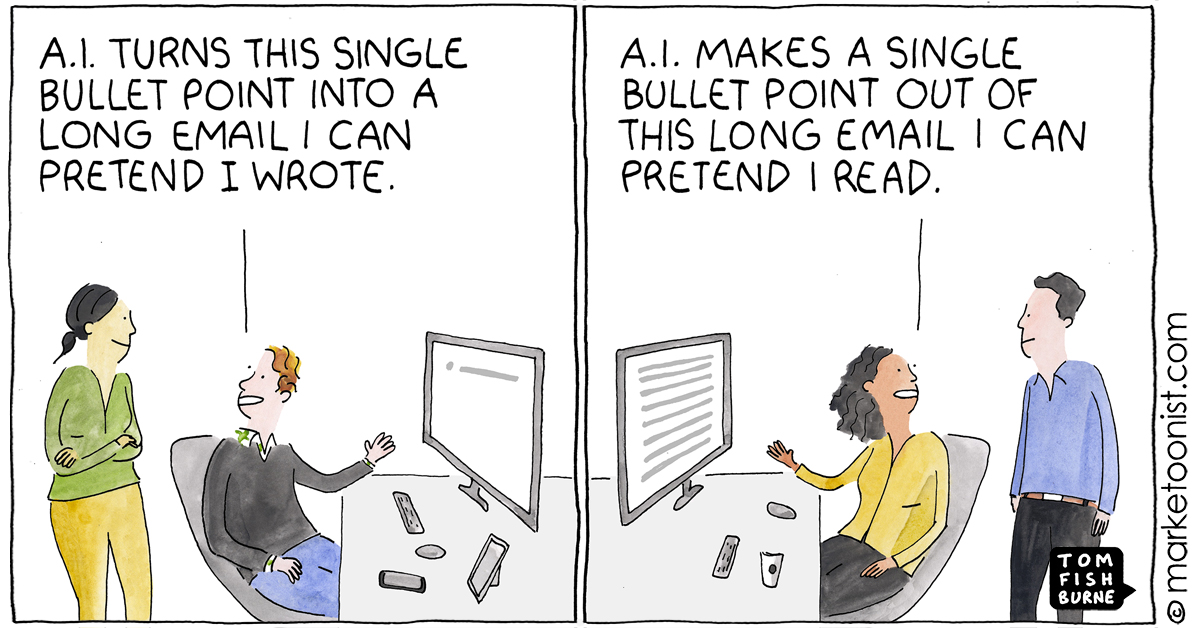
This comic from “marketoonist.com” showed up on LinkedIn somewhere and made me laugh. It depicts one person boasting about using AI to expand a single bullet point into a lengthy email, and another person boasting about using AI to condense a long email into a single bullet point.

I think the reason this is funny is because it’s just possible enough to be believable, and highlights an ironic office process dysfunction in a novel way. It’s a ChatGPT joke, but it’s also a foolish workplace norms joke.

Let’s dig into what we can learn from it.

Read more →

Success fills available space

This might not be the right title. Break this up into smaller bits and just post smaller things.

There are some separate themes here:

  • Don’t manage the “how,” manage the “why.” Very Simon Sinek, very Art of Action. As a leader, especially a senior leader several levels removed from the people doing the “real work,” you serve the organization best by focusing on the intent, the desired outcome.

  • Focusing on “why” and “intent” are tactical implementations for the goal of providing space and trust to teams. Fire people when they’re not understanding the outcome, when they’re defying the desired outcome. Don’t expect them to do exactly what you would do.

“If you could imagine it, you wouldn’t need a team to do it.”

Teams build things you couldn’t build on your own. By definition, a team builds something they invented. It serves a purpose that you’ve defined, but if you could imagine all the details of what it needed to be, why did you hire a team?

I can already think of some leaders saying “I know how it should be, I just can’t do it fast enough by myself.” Maybe that’s a bad reason to be in leadership? If you just need speed, or parallelism, bring in contractors.

But what’s the thesis?

  • Leadership is about being a conduit for customer and business need

  • Team needs are secondary to customer needs, but still more important than your personal needs

  • Of course this is contrary to all of our evolutionary instincts and our sense of ego (?)

  • The limits of success for your team, beyond obvious skill and resources constraints, are at the edges of your own ego

  • If you want your team to succeed, you need to get out of their way

  • Chasing promotions, profits, etc., is the opposite of truly chasing success. Success is a lagging proxy metric so it’s hard to pin down (?)

What could we learn from the failures of the Boeing 737 MAX and the Sears retail chain? What leadership mistakes were made?

Success expands to fill the available space. One way to be certain your team will have little to no success is by filling all the available space with your ego.

What does the defunct retail chain Sears, Roebuck and Company have in common with the Boeing 737 MAX? Both catastrophically failed because leaders let their egos suffocate their teams.

Sometimes the key to success—or to avoiding failure—is to do the thing that many leaders are afraid to: let go.

Read more →

How to agree on something 🔊

The foundation of a healthy working relationship is agreement. Even when people have differences of opinion—and they always will—getting everyone on the same page about broader goals and individual motivations produces better outcomes.

As a manager, you can use a few conversational techniques to create powerful agreements that drive productivity and job satisfaction. Let’s take a look at a couple of them.

Read more →

"Do more reorgs" with Brian Guthrie 🔊

Instead of bringing you another analysis of a leadership topic laced through and through with my opinions, I thought it would be fun to share a new perspective. This time, from my old friend and former start-up colleague Brian Guthrie.

Brian recently started a company to help tech leaders visualize and execute smooth re-orgs, so we talked about that. What makes re-orgs hard? What would make them easier?

I strongly encourage you to listen to the podcast episode! The below transcript is accurate enough, but fails to capture the spirit of the conversation in many ways.

Brace yourselves; this is a longer one, but I really think you’ll take something away from it.

Enjoy!

Read more →

On the importance of writing 🔊

Everyone is required to write almost continuously at work, and writing remains the single best solution to the many communication and collaboration challenges that face our fast-moving, distributed teams. Yet writing skill in the workplace is greatly varied in my experience, and few companies make a deliberate investment in improving the writing ability of their workforce.

Can you think of any other skill that is required, crucial, has a wide breadth of mastery with a direct impact on the operations of a business, and which nobody is ever trained to do?

Read more →

Simpler isn't actually better 🔊

One of the most challenging aspects of technical leadership, or any leadership for that matter, is managing complexity. People, plans, markets, and software systems, just to name a few, are all wildly complex things. Finding ways to separate the signal from the noise, set reasonable expectations, and observe results can be daunting.

We’re admonished to “keep it simple, stupid,” and given heaps of tools that promise to reduce any complexity to its essential, manageable bits. Tracking systems, dashboards, dependency maps, OKRs, and box-and-whisker plots abound.

Yet history has taught us that seeking simplicity, while often well-intentioned, can be disastrous. To be the nimble and effective leader who can manage through complexity with ease, you’ll need to do one thing that many leaders never learn to do: let go.

Read more →

The live debugger for any situation 🔊

When a program doesn’t work and you don’t know why, the first thing you reach for is a debugger. Whether that’s a process-attached tool like GDB, the Dev Tools panel of your browser, or just a series of logger.log("now I'm here (3)"); statements littered through the code (my preferred method), you’ll soon have it figured out.

What if there was a way to apply the same deliberate, iterative approach to management challenges? Surprise, there is!

Read more →

Innovation isn't an accident 🔊

The pandemic forced a global, unexpected, non-consensual remote work experiment and the results are still being analyzed. But one thing that has become abundantly clear over the past three years is that many leaders don’t believe that remote workers can innovate.

The dominant theory advanced by these leaders is that in-person work leads to serendipitous moments and those unexpected interactions create unpredictable but positive outcomes for product development.

There are two key flaws in that theory:

  1. Innovation doesn’t require serendipity.

  2. Serendipity in the office is a myth.

Read more →

Create a "pit of success"

What if there is a way to lead such that success is inevitable? What if, as a side-effect, that leadership also improved trust, intrinsic motivation, and job satisfaction? What would it mean for you, personally, to know how to do that?

You’re probably thinking, “If that existed, everyone would be doing it, and we wouldn’t have any volatility, uncertainty, chaos, or ambiguity in our work!”

Well, it does exist, and it’s remarkably simple. But simple doesn’t mean easy, and anything this important takes time and effort to achieve. If you are up to the task, you can change the way you lead forever.

Read more →

Great leaders humanize 🔊

All companies beyond a certain size are sociopathic colony organisms that regard their employees as inconvenient gut flora (to borrow an expression from Cory Doctorow).

At some point in their growth, many companies consider whether to stack-rank employees by their performance ratings; or publish management guidelines referring to groups of humans as “resources”; or undertake vast re-orgs solely on the basis of metrics-based abstractions.

These efficiency- and profit-seeking behaviors will inevitably be suggested and discussed, though they are universally dehumanizing to employees.

Your highest calling as a leader is to remember that your company requires employees in order to function, that employees are humans, and that the only thing that differentiates your company from an “immortal paperclip-maximizing artificial intelligence” is how you treat them.

Read more →

Ensure your happiness with a "pre-mortem" 🔊

One of the best ways to improve a system is to carefully and objectively analyze its failures. You’re probably familiar with getting a group of engineers together for a “post-mortem” conversation after something went terribly sideways.

A post-mortem, when done correctly, is almost magical in its effectiveness, which is why they have become so common. But when it comes to figuring out what you really want, and what will give you lasting happiness in work and life, well… Waiting until it’s over is too late!

But, interestingly enough, we can use one of the same tools we bring to bear in a post-mortem to create a clearer picture of what our values are and how we want to show up in the world.

Let’s call it a “pre-mortem.”

Read more →

To improve productivity do nothing 🔊

Let’s say you want your workers to be more productive. As the leader of a large and complex organization, there are numerous levers that you could pull… But which ones will improve the work output?

As it turns out, the answer is none of them. Or all of them.

Read more →

What's your cathedral? 🔊

One of my favorite topics is culture and incentives, which I’ve written about before. Culture is the name we give to all the behavior of a group, which is mainly influenced by incentives.

Part of your job as a leader is to create the culture by aligning values, incentives, and your own behavior. But when it comes to getting the day-to-day work done, ordinary incentives aren’t always enough.

That’s where the cathedral comes in.

Read more →

What are your tendencies?

Do you know enough about yourself to lead with confidence?

Great managers are curious. Curiosity leads to new awareness, which leads to opportunity, which ultimately leads to success. People with more self-awareness perform better at their jobs, get more promotions, and lead more effectively1.

Today I’ll offer the first of many tools for improving your self-awareness: The Four Tendencies.

Read more →

Why doesn't someone fix meetings? (Part 2)

In part 1, I offered my “table stakes” requirements for organizing a stellar meeting. In researching for this series, I discovered that the vast majority of articles written about meeting etiquette are written for meeting organizers.

That makes sense, because of course the organizer of a meeting has the most control over whether it’s going to be a shitty one or not. Yet I’m told that attendees of shitty meetings outnumber organizers by as much as ten to one!

So what can we do as attendees to improve this whole meeting situation?

Read more →

Why doesn't someone fix meetings? (Part 1)

Have you ever gotten to the end of a day and looked back and wondered what it was you accomplished all day long? You were in back-to-back meetings for most of it, hardly a moment to get a bite to eat, and yet… What actually happened?

I think we’ve all had days like that. But why are some of those meetings so… Unproductive?

An early 2010s billboard from GPS maker TomTom proclaimed:

You are not stuck in traffic.

You are traffic.

We are desperate for a “solution” to this neverending “meeting problem,” but the question we never seem ready to ask ourselves is… What can I bring to improve this situation? Well, let’s get into that.

This is part one of a multi-part series. In this article, I focus on the low-hanging fruit: how to be a stellar meeting organizer.

Read more →

Creating change

All meaningful change is an act of creation.

In fact, when setting out to make substantial change happen, I believe that most people overlook one key element that must be woven through all successful, durable change: understanding.

Today, let’s build a new framework for change that puts understanding at its core.

Read more →

What's really important?

The best work is done by teams who, frankly, give a shit about what they’re doing. If your team is showing up just to get paid, you aren’t getting the optimal results, period.

That doesn’t mean you need teams of single-minded idealists who exalt the team and company’s mission and would walk over hot coals without question if asked. Rather, it means you, their manager, need to connect their work to a purpose greater than them.

In today’s issue: how do you do that?

Read more →

Making (great) decisions, part 2

In part 1, I looked at simple methods of delegating or prioritizing decisions, and one option for making decisions quickly based on “operating principles.”

This part will dive deeper into more complex methods for wayfinding within decision-making scenarios and processes that create confidence and alignment within your surrounding team or teams.

Read more →

Making (great) decisions, part 1

Long ago, I read this piece of advice, which has lived rent-free in my brain ever since:

First make the bug easy to fix, then fix it.

What I think it meant was to approach a bug as an opportunity not only to improve the software by removing the bug, but also to make it harder for the software to become buggy later (by adding tests and consequently improving the architecture).

As leaders, one of our primary exports is decisions. We all make them, every day, and sometimes those decisions have far-reaching downstream consequences.

Read more →

Quiet quitting is a huge opportunity

I know, I know, you’ve probably heard enough about “quiet quitting” by now, but, if you’ll indulge me, I think you could be looking at a huge opportunity.

First off, quiet quitting isn’t new. It’s a term freshly birthed from the roiling cultural phenomenon called TikTok, but it means the same thing as “disengagement,” or “coasting,” or even the Silicon Valley-famed “resting and vesting.”

What they’re not talking about on TikTok is that managers account for at least 70% of the variance in employee engagement scores1. If you’re reading this, that’s probably you.

Are people on your teams “quietly quitting?” Does it matter? What can you do to ensure that your teams are engaged, whether they are “quiet quitters” or not?

I will cover all of that, and more, right here!

Read more →

So you want to hire some engineers?

It should go without saying that one of the most important—and most challenging—responsibilities of an engineering manager is hiring.

In a recent survey of 581 tech founders and executives1:

  • 62% say it takes 4 months or more to hire top product and engineering talent on average.

  • 67% agree that the “traditional recruitment process” is broken, taking too long and costing too much.

At the same time, tech workers are more restless than ever before, changing jobs at a staggering rate.

What should you do if you want to succeed in hiring the engineers you need for your team today? As we say in most engineering matters, “it depends,” but these are my earnestly held beliefs about what matters most:

  1. Attract (enough of) the right people,
  2. Conduct an exceptional interview, and
  3. Sell what’s important.

This is going to be a long one because there is a lot to say and it’s all important.

Read more →

What engineering managers must un-learn

You got to where you are by very precisely instructing the computer to do something quite complicated and often nuanced. Maybe you spent years in school, or years of self-directed study to learn how to do this. You have been rewarded for demonstrating things like:

  • Ingenuity
  • Resourcefulness
  • Grit, or persistence

Then you entered management. Did anyone teach you how to manage? Did anyone tell you what “great management” should look like?

All your years of software experience barely help you to excel at management.

In fact, some of the habits you were rewarded for as a programmer are actually hurting you. Today I’ll share some habits you should strongly consider un-learning.

Read more →

Be careful giving advice

It’s that question many managers hunger to be asked: “Can you give me some advice?” There is nothing we love more than when our experience is valued. We want to help people by offering anecdotes, observations, and direction. Almost all advice is well-intentioned, and most of it is probably good.

But when is advice not helpful? What if advice does more harm than good?

Read more →

Creating a culture

Whether you lead one team or 100 teams, you no doubt want to create and reinforce an excellent culture. When companies are competing for the top talent, and when they all offer compensation and perks that would make your parents blush, culture may be the last true differentiator.

But building a culture, and preserving it through years of growth and change, is incredibly hard. I know, because I’ve worked at start-ups that failed to build a coherent culture at all, and I’ve worked at scale-ups who had a great culture and lost it.

So, what’s the secret to creating and defending an awesome culture?

Read more →

Finding durable happiness at work

Over the last year or so working at my corporate job, I’d often get up in the morning and look at my work calendar with a sense of dread. I spent hours and hours every week doing “important” and “necessary” activities that, to me, created no value at all for the world. I’d end the day feeling mentally and emotionally drained.

It’s clear to me from my work with engineering leaders that a feeling of contentment or joy in a senior management role is far from guaranteed. In fact, it’s typical for a rise in seniority to be accompanied by an apparent decrease in contentment.

There is no single reason for why this happens that applies to everyone, but there is one key factor that predicts how happy you’ll be in your job overall, regardless of seniority.

If you understand this one incredibly simple thing, you can guarantee job satisfaction forever.

Read more →

Tips to move any conversation forward

As a member of the “leadership team” at the various companies I’ve worked for, a lot of my job was talking to people. Leads of other teams, engineers, “senior management,” and so forth.

Most of the time, those conversations went just fine, but occasionally we’d get stuck. There are two important ways in which a conversation can get stuck, and I call them “the logjam” and “the loop.”

It’s frustrating for anyone to feel like the conversation isn’t going anywhere, and sometimes that leads to conflict and distraction from solving the problem everyone came to solve, so here are my coaching-inspired tips for moving any conversation forward.

Read more →

Go with your gut

Do you make decisions intuitively or analytically?

What if I told you that analyzing your situation might be more of a waste of time than you think? What if I told you that your intuition is actually a massive window into your intelligence?

In fact, ignoring the importance of intuition almost destroyed the Coca-Cola company.

Read more →

Just do the work

As a manager, I’ve frequently had conversations with team members about how they can get that promotion they’re after, and as a colleague or friend I’ve also been asked quite often for advice on breaking into the tech industry or interviewing for a software job.

While there are certainly some helpful “rules of thumb,” the best advice that I can give anyone is “just do the work.”

That might sound trite, and it is, but it’s still true. If you don’t want to listen to me, take the advice of two world-renowned comedians and one computer science professor with a Ph.D. from MIT.

Read more →

Seek challenge, start now

The only reliable way to achieve anything substantial is through consistent, sustained action. Moreover, any truly substantial accomplishments take a long time, on the order of years.

In this, there are two key hurdles to overcome:

  1. If you want to achieve something substantial, start now, and don’t stop. Doing something, no matter how small, is infinitely better than doing nothing.

  2. The penalty for avoiding sustained and consistent progress, especially in technology, is obsolescence.

If you want to achieve more than you’ve ever dreamed, you can. The main reason you think you can’t is because it’s going to take years, and you can’t see all of the steps from where you are right now, so to you it appears to be impossible.

Let’s break it down.

Read more →

Do you hate to ask for help?

I have had trouble asking for help for nearly my entire life. I don’t know when it started or what caused it, but at some point in my childhood I learned that knowing correct answers is rewarded, and asking for help is admitting that you don’t have the correct answer.

That simple idea led me to perpetrate, quite literally, decades of self-sabotage. Rather than ask a question or offer a guess, I just kept my mouth shut.

Read more →

The when/then trap

Warning: This article briefly mentions self-harm. If you (or someone you know) need support, call the toll-free, 24/7 National Suicide Prevention Lifeline at 1-800-273-8255. You can also text HOME to 741741 for free, which offers 24/7 support from the Crisis Text Line.

Are you looking to get promoted? Why?

It’s an honest question; what is important about that promotion, for you? Maybe it’s money, recognition, or power. Maybe it’s what you think you’re supposed to do.

Whatever the reason, it might be wrong.

Read more →

Hi and why

In an increasingly asynchronous and distributed workplace, it’s super important that managers learn how to leverage the strengths and avoid the pitfalls of a text-oriented way of communicating.

Done right, asynchronous communication can increase clarity, make decisions more durable, and even enforce equitability within teams. But done wrong, it can hinder progress, create churn, and even add unnecessary stress and anxiety.

Here are a few things you can do to be sure you’re getting communication right in your distributed teams.

Read more →

Ambition to opportunity ratio

You want something in your career. What is it? Advancement in specific skills? Bigger problems to solve or bigger teams to lead? Occasion to showcase your unique talents? The chance to work with specific people you look up to, and to learn from them?

No matter what your ambition, your ability to achieve it is built from two parts: your resolve, which is your capacity to do the things you must do; and your environment, or the presence of opportunity.

I call this the “ambition to opportunity ratio.”

Read more →

It's OK to be bad at things

This is one of my favorite mottos, one that I’m working very hard to live up to myself:

If you want to be good at something, you have to be OK with being bad at it for a while.

For as long as I can remember, I have had anxiety about being bad at things, and it has held me back. Do you struggle with failure? Do you want to know how to fix it? I might be able to help.

Read more →

Overcome impostor syndrome

“Impostor syndrome” is a belief that you don’t deserve the success or luck that you enjoy. In the tech world, it is often a sense that you aren’t “living up to” the title you hold, or team you lead, or something like that.

Impostor syndrome can be quite crippling, because it robs you of the confidence to take risks, make mistakes, and grow as a person and an employee.

These are some of the tricks that I’ve discovered for overcoming impostor syndrome and freeing yourself to grow, learn, and create.

Read more →

Defeat analysis paralysis

Are you an “analyzer?” Do you like to know all the details about a situation before committing to an action? Do you sometimes find yourself stuck in a cycle of evaluating and re-evaluating options?

Whether you are or not, you almost certainly work with people like this. One of my internal saboteurs is the Stickler, and he likes to tell me to “do it perfectly or not at all.”

This is a recipe for disaster or—at the very least—for stagnation.

Read more →

Talk to your saboteurs

What if the only thing standing between you and the growth, joy, and success you desire is… You?

Everyone has inner parts of themselves that sabotage, distract, and create self-doubt. I’m not sure who originally coined this, but these parts of us are often termed “saboteurs” or “inner critics.”

Once you learn what yours are, and what they look or sound like, you’ll start to recognize when you’re standing in the way of achieving your own desired goals.

Read more →

Go slow to go fast

“Execute with urgency.”

“Deliver with agility.”

“Bias to action.”

You’ve probably heard some version of this sentiment in your work life, as modern businesses have placed increasing value on speed. This is for good reason: we know that many industries are “winner take most,” and whoever builds that competitive moat first can come out on top.

But what if I told you that many modern companies miss the point completely? What can you do to model true speed and to help your team do the same?

Read more →

Find your moment to pause

If you don’t recognize that symbol to the right, you are (perhaps) among the lucky few. The icon is the “message waiting” indicator for the very popular workplace collaboration tool Slack, and it’s been slowly killing me.

Read more →

The wheel of management

Along my coaching journey I’ve come across a bunch of tools designed to help a coaching client to see their situation differently than they do naturally. There is immense power in altered perspective, and it’s one of the reasons that coaching works so well—most people naturally see things the way they see them, and that’s not always what is needed.

One such tool is called the “Wheel of Life” (pictured below). As I was playing with this tool myself, I wondered: why couldn’t this be used for work?

Well, I think it can, so I created my own version and I am going to share it with you here.

Read more →

Open any door

You’ve heard the saying “You can lead a horse to water, but you can’t make it drink.” Or maybe you’ve heard the more modern version spoken by Morpheus in The Matrix, “I can only show you the door, you’re the one who has to walk through it.”

Opportunity abounds, and you face choices every single day about how to invest a slice of your time in walking through one of those doors. But… Which one should you walk through?

Any door. Literally choose any door. You ready?

Read more →

Not just operators

To make a real impact in your work, and on the world, you need more than one type of person. That sounds obvious, given our understanding of the importance of diversity, but we need more than differing perspectives, we also need differing personalities, and there is a simple way to think about it that can help you build a successful environment around you.

The moment I began to understand how I fit into these three simple types, it gave me an entirely new perspective on my work.

Read more →

Change your life with two words

Everything that you see, do, and feel are just thoughts. If you think I’m crazy, or wrong, or even if you think I’m correct… Those are thoughts, too. Our entire life’s experience from end to end is just millions of thoughts.

“Cool, so what?” you’d say, if you were here.

Once you truly understand that everything is a thought, you begin to unlock the superpower that we all possess: the ability to influence our thoughts and materially change our lives for the better. It can start with just one word. So today, I’ll give you two.

Read more →

Make your values work for you

Last week, I wrote that passion for your job is a mistake, which attracted a bit of attention, and some of the questions and conversation uncovered confusion about passion vs. values, and what it looks like to be fulfilled in your work even if you aren’t passionate about it.

I’m not an expert, just a traveler on a values-aligning journey myself, so I can’t be authoritative, but I think I can help break this down.

In short, if you want to achieve fulfillment at work, and leave work each day feeling happy, put your values to work for you. By the end of this article you’ll have an idea of how to do that.

Read more →

Passion for your job is a mistake

Job listings, especially at start-ups, frequently appear to be in search of “a passionate team player to take this rocketship to the moon,” or whatever.

Even if the job is at a company with a mission that aligns with your values (which is a great way to choose a job), be cautious that you aren’t taking the job for the wrong reasons, because the outcome could be burnout, or worse.

Read more →

Beware the "hybrid role"

Have you ever heard the advice that you shouldn’t buy a combination printer/copier/fax machine because even though it can do all three things it won’t be very good at any of them?

Well, few people need a fax machine anymore so perhaps that point is moot, but when it comes to our jobs, it becomes harder to excel in any one area of skill as the number of areas you’re responsible for increases.

Read more →

Let's stop saying "resource"

I almost can’t believe it, but it’s still happening. It’s the year 2020 and business leaders are still saying things like “I need one or two senior Java resources.”

This word, “resources,” when used to refer to people, is damaging to your organization. There are very few cases where people working on a project are fungible assets in all practicality, but even in those cases, not recognizing them as human beings is insulting at best.

Read more →

It's time to talk about micromanagement

In the early ’00s, I worked for a start-up in the education technology space. It isn’t important what we did (and the company no longer exists), but my experiences there shaped my view of what management should be like.

The worst manager

Early on, there were only about six of us: the founder and president, whom I’ll call “Paul;” the CEO, whom I’ll call “Bill;” and four tech folks including me. Paul had hired Bill to manage the operations of the business so that he could, ostensibly, focus on the sales and customer relations.

Read more →

You've got this

Think of a time when you had a challenge in front of you that you were anxious or uncertain about.

Now think of one of those times when someonea parent, a manager, a coach, a teachersaid, “You’ve got this.”

How did that make you feel? Probably pretty good, right? It feels good when someone shows you that they believe in you. Especially when that person also knows how difficult the challenge is for you.

Read more →

Listen

Right now, everyone is trying to understand what is happening and how to react. There are many things that we can all do, individually and socially, to fight racism, hatred, and violence in our communities and the country. This article isn’t about where to donate or protests to participate in or petitions to sign.

This article is about the one seemingly simple thing that we must all do. Especially if you are a manager, and especially today.

Read more →

Focus on these six things

The computer and information technology sector is projected to grow faster than any other occupation over the next ten years.

As more and more people enter the field, the need for management grows, too. The software engineering field is notoriously fickle about hiring “outside managers,” and for good reason; research shows that the most effective managers not only understand the work of their teams, but can actually do the work, too.

Read more →

How to be a great manager

In 2002, Google decided to eliminate managers. It went terribly (as you might guess) and managers were reinstated. Still, Google remained so skeptical of management that, in 2008, they assigned a team of researchers to go figure out whether management was useful or not.

The effort was code-named Project Oxygen. The result of that research is some of the highest fidelity insight into what makes great managers great that we have ever had.

Read more →

Coaching in weird and difficult times

During uncertain, difficult, extraordinary times, your job as an engineering manager fundamentally changes.

When the world is predictable and the team is fully engaged, you can focus on output, set and model a high bar, give frequent feedback, and push the team to be the best that it can be. But when the world is upside down and everyone is living a reality they didn’t sign up for, the best thing you can do is be totally supportive.

Read more →

Three tips for successful one-on-one meetings

“Ugh, what are we even going to talk about?”

How many times have you looked at your calendar, realized that you have a one-on-one meeting with someone on your team, and fallen into a spiral of anxiety about how you will fill the time? Maybe you end up talking about their current project’s status, or you grab a couple of questions from that “101 questions to ask in a one-on-one” list and ask those, or, almost the worst of all, you just chat about life and industry news for 45 minutes.

Read more →

In uninspiring times, tap into the power of purpose

We had suffered a massive outage. It was so big that it made headlines across our industry, caused tangible customer churn, and sent ripples of distrust through the businesses we served. While nobody would wish for this to happen, it is something that will happen to practically any technology business eventually, and what is important is how you respond.

I thought that my company responded perfectly. They openly apologized, took responsibility, and enacted changes through the product engineering organization to shore up the stability and reliability of our systems. It was the right thing to do.

Read more →

A mistake I made leading at a scale-up

It was as if a light bulb had turned on over my head, like in cartoons.

I was discussing some performance issues in our application with the team, and I had laid out what I thought were the things we could do on our own and what we would probably need to lean on our platform support team to help out with.

I then roughly described how I thought things could play out depending on whether the platform team prioritized our concerns or not, and how that might impact what we did next.

Read more →

The one mistake most new engineering leaders make

When I work with engineers who have decided to begin managing people, there are a few opportunity areas I look out for that I see time and again. New managers make mistakes, just like anyone does when they are learning a new skill, and there’s nothing wrong with that. But there is one mistake that is by far the most common and it can be one of the hardest to learn when you’re new to it.

Read more →